The Quick Answer
Hard techno distortion is not about pushing a plugin to maximum drive. It is about controlled harmonic shaping across different elements of the track. Professional producers distribute distortion across kicks, bass, synths and drums while protecting the sub frequencies between 45 Hz and 65 Hz. The goal is to create aggression and density without losing low-end stability or mix clarity.
Hard techno is designed for large warehouse sound systems.
At tempos between 145 and 155 BPM, the music must remain powerful, dense and controlled even at extreme sound pressure levels.
Distortion is one of the main tools that gives modern hard techno its aggressive character. It increases harmonic content, adds texture and allows sounds to cut through dense mixes.
However distortion must be applied carefully.
When used incorrectly it creates mud in the low frequencies, harshness in the upper mids and unstable low-end energy that collapses on club systems.
Understanding how distortion works across the entire mix is essential for building club-ready techno productions.
Tools That Simplify Distortion Workflows
Distortion chains can become complex when layering multiple kick components or drum groups.
Many producers now use specialized tools to speed up this workflow.
For example, layering tools like Hammer allow producers to stack attack, body and sub layers while applying controlled distortion stages without complicated routing.
However tools only work well when the source samples are engineered correctly.
That is why starting with curated sound libraries makes a significant difference in production speed and mix quality.
You can learn more about selecting high-quality sounds in the guide How to Choose Hard Techno Sample Packs Like a Professional Producer
Professional Distortion Checklist
Before adding distortion to any techno element verify that:
- sub frequencies remain stable
- transients are not flattened
- mud around 200–400 Hz is controlled
- aggression is focused in the midrange
- high frequencies remain smooth
- the mix translates well in mono
If these conditions are not met, distortion will reduce clarity instead of improving impact.
Final Thoughts
Distortion is one of the defining characteristics of modern hard techno.
But aggressive sound does not come from pushing distortion to the maximum.
It comes from controlled harmonic shaping across multiple layers of the track.
When applied correctly, distortion increases power, density and industrial character while preserving the elements that make techno work on large sound systems.
In hard techno production, aggression must always remain controlled.
Because on a warehouse system running at 150 BPM, uncontrolled distortion quickly becomes uncontrolled noise.
Why Distortion Is Essential in Hard Techno
Distortion reshapes the waveform of a sound and introduces new harmonics.
These harmonics increase perceived loudness and give techno sounds their aggressive industrial texture.
In hard techno production distortion helps achieve:
- stronger midrange energy
- higher perceived loudness
- more aggressive drum texture
- thicker synth layers
- better translation on club systems
Without controlled distortion many sounds feel flat and weak when played on large sound systems.
But distortion must always be balanced with frequency control.
Excessive distortion often introduces:
- mud between 200 Hz and 400 Hz
- harsh peaks between 3 kHz and 6 kHz
- unstable sub frequencies
- reduced transient punch
Professional producers therefore treat distortion as a layered sound design process, not a single effect.
Understanding Distortion Frequency Zones
Different frequency ranges react very differently to distortion.
Knowing where to apply distortion is one of the most important aspects of techno sound design.
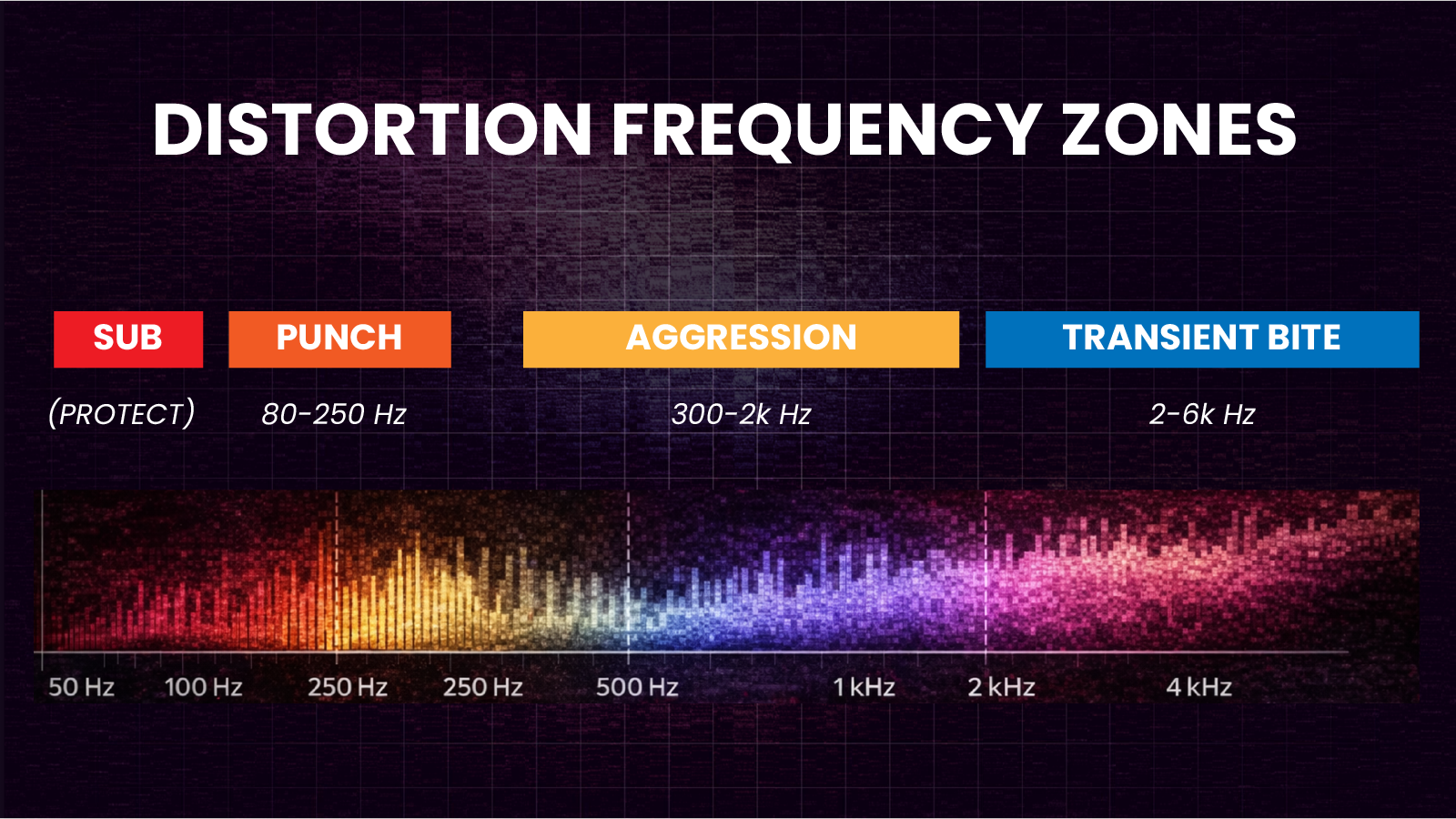
Sub Frequencies (0–65 Hz)
The rule is simple: protect the sub.
Heavy distortion in this area often destabilizes the low end and reduces mono compatibility.
Most hard techno kicks have a fundamental between 45 Hz and 65 Hz, which should remain relatively clean.
Light saturation may be used, but strong distortion is usually avoided.
Punch Zone (80–250 Hz)
This range defines the physical impact of a sound.
Controlled distortion here can increase density and perceived loudness.
However excessive drive often creates muddy mixes.
Professional producers typically apply only subtle saturation in this range.
Aggression Range (300 Hz – 2 kHz)
This is where distortion becomes powerful.
Most of the industrial texture of hard techno lives in this area.
Distortion applied here creates:
- drive
- texture
- forward energy
This frequency band is where distortion can be pushed the most aggressively.
Transient Bite (2 kHz – 6 kHz)
This range controls attack clarity.
Small amounts of distortion or saturation can help drums and synths cut through the mix.
However this area can quickly become harsh if distortion is uncontrolled.
Dynamic EQ or multiband processing is often used to tame peaks.
Where Distortion Is Used in a Hard Techno Track
Distortion is rarely applied to only one element.
Modern hard techno distributes distortion across several parts of the mix to create a dense and cohesive sound.
Kick Distortion
The kick is the foundation of the track and requires careful distortion control.
A typical hard techno kick contains:
- fundamental between 45 Hz and 65 Hz
- punch between 80 Hz and 120 Hz
- transient click around 3 kHz to 5 kHz
Distortion should enhance the body and aggression of the kick while preserving the sub stability.
Typical workflow:
Clean kick
→ light saturation
→ parallel distortion
→ soft clipping (1–3 dB)
For a deeper breakdown of kick engineering and distortion staging, read the full Hard techno Kick Tutorial 2026 : From Raw Samples to Club-Ready Monsters
Bass and Rumble Distortion
Rumble bass relies heavily on distortion to create its characteristic texture.
However the sub portion of the rumble should remain clean.
Professional rumble distortion workflow:
Clean sub layer
→ saturated mid layer
→ distorted high-passed layer
This keeps the sub stable while generating harmonic energy above 120 Hz.
Synth Distortion
Distortion is widely used on synth layers in hard techno.
It creates the aggressive industrial tone heard in modern warehouse productions.
Common techniques include:
- saturation for thickness
- overdrive for harmonic density
- parallel distortion for aggression without losing clarity
Synth distortion typically focuses on the 300 Hz to 3 kHz range where harmonics are most audible.
Drum Distortion
Drums can tolerate stronger distortion than bass elements.
Producers often distort:
- hi-hats
- rides
- percussion loops
- claps and snares
Distortion adds rhythmic energy and industrial character.
Because these sounds contain little sub energy, they can be pushed harder without damaging the mix.
Drum Bus Distortion
Instead of distorting individual drums, many producers also apply light saturation to the entire drum group.
Typical approach:
Drum bus
→ saturation
→ soft clipping
→ subtle parallel distortion
This helps glue the drum elements together and adds density to the rhythm section.
Usually only 1 to 2 dB of harmonic drive is necessary.
FX and Atmosphere Distortion
Distortion is also used creatively on sound effects and atmospheres.
Examples include:
- industrial noise layers
- sweeps and transitions
- reversed impacts
- background textures
Distortion adds harmonic complexity and helps these elements remain audible in dense mixes.
Parallel Distortion: A Key Production Technique
Parallel distortion is widely used in techno production.
Instead of distorting the entire signal, producers blend a distorted version with the clean signal.
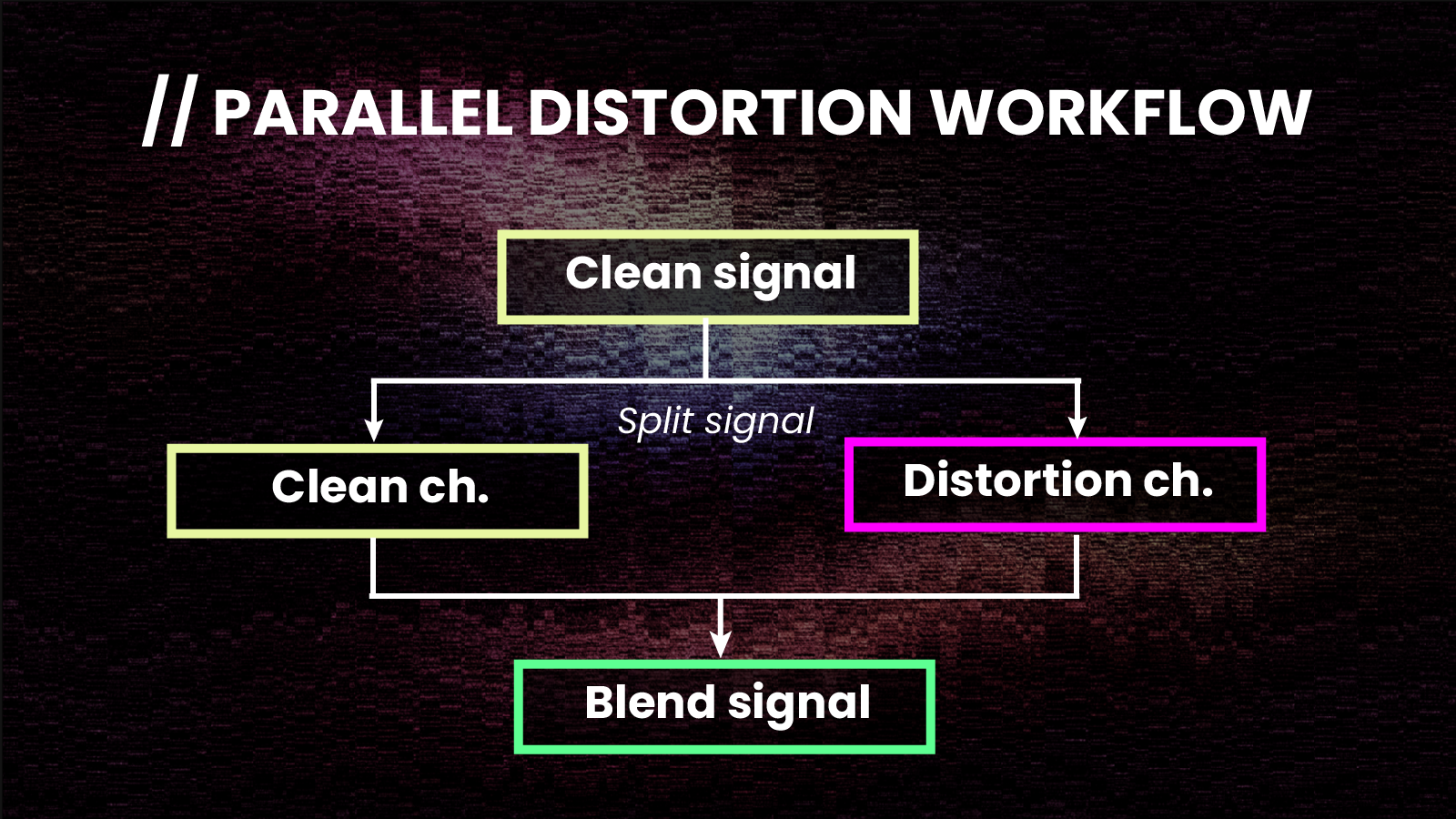
Typical routing:
Clean signal
→ send to distortion bus
→ blend 20–40 %
Benefits of parallel distortion:
- preserves transient punch
- protects low-end clarity
- adds harmonic density
This technique allows aggressive distortion while maintaining mix control.
Distortion vs Saturation vs Clipping
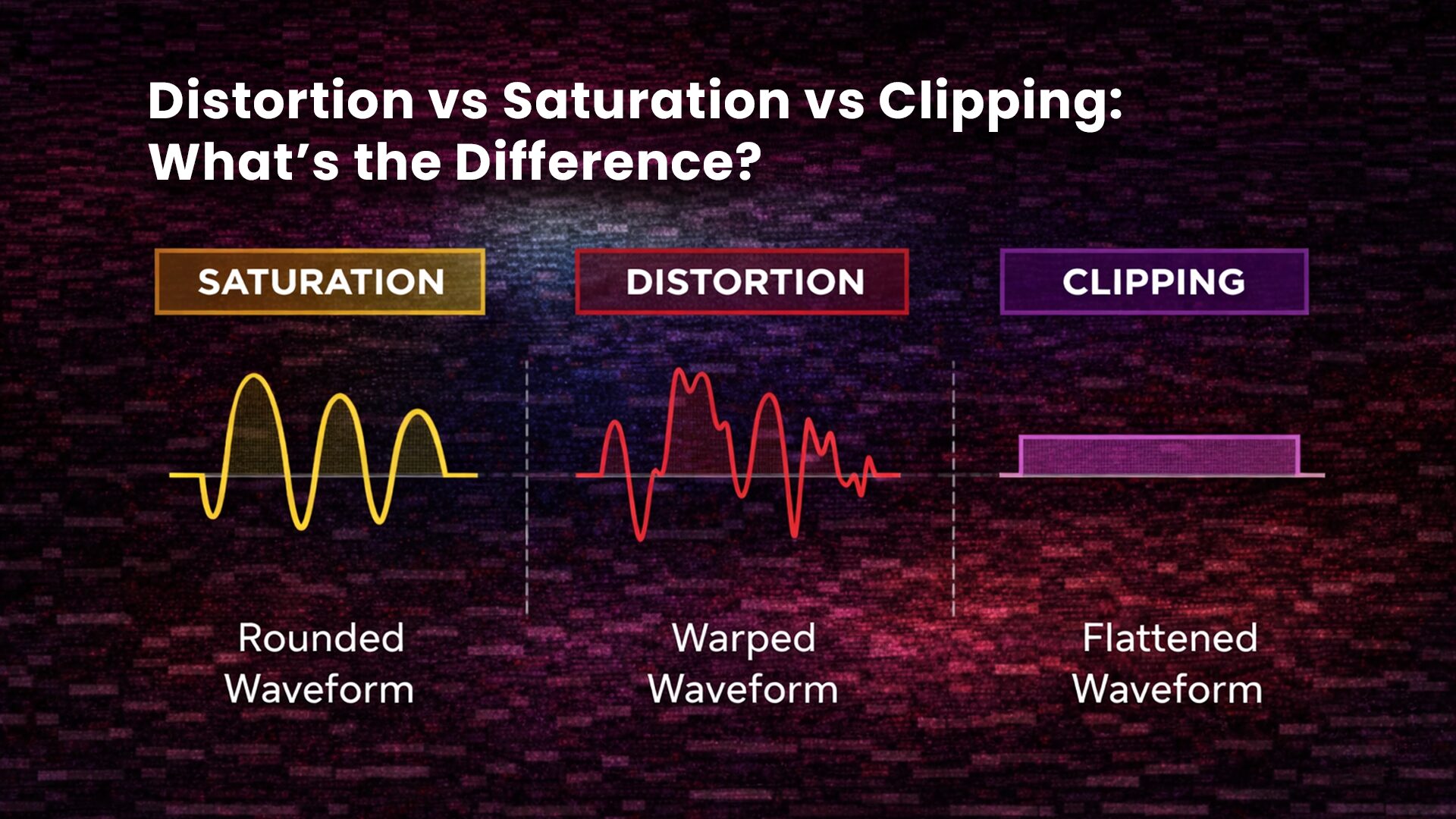
In hard techno production, three processes are often used together to shape aggressive sounds: saturation, distortion and clipping.
They are closely related, but they serve different purposes in a mix.
Saturation
Saturation introduces gentle harmonic coloration. It thickens sounds and adds warmth while keeping the original dynamics relatively intact. Producers often use saturation to give kicks, drums or synths more density without drastically changing their character.
Distortion
Distortion is more aggressive. It reshapes the waveform more dramatically and generates stronger harmonics. In hard techno, distortion is commonly used to create industrial textures, midrange aggression and forward energy in synths, drums and bass layers.
Clipping
Clipping works differently. Instead of adding harmonics gradually, it limits peaks by flattening the waveform. This increases perceived loudness and helps sounds remain powerful in dense mixes and on large club systems.
In modern hard techno production these three processes are rarely used in isolation. They are often combined in stages:
Saturation builds density
Distortion adds aggression
Clipping increases loudness
Each technique plays a specific role in the final sound design.
If you want to understand when to use each process, how they differ technically and which plugins producers rely on, we cover this in a dedicated guide:
→ [available soon]
This deeper article explores real workflows and recommended plugins for beginner, intermediate and professional producers.
FAQ
What type of distortion is best for hard techno?
The best distortion for hard techno depends on the element being processed.
Saturation is commonly used on kicks and drums to add harmonic density, while stronger distortion or overdrive is applied to synths and mid-range bass layers. Many producers combine saturation, distortion and soft clipping to achieve aggressive sound design while maintaining mix control.
Should you distort the sub bass in hard techno?
In most cases the sub bass should remain relatively clean.
Hard techno kicks usually have their fundamental between 45 Hz and 65 Hz, and heavy distortion in this range can destabilize the low end. Producers typically distort higher layers above 120 Hz while preserving the sub layer to maintain power and mono compatibility on club sound systems.
Why does distortion make techno sound louder?
Distortion increases the number of harmonics in a sound.
These additional frequencies raise the perceived loudness without necessarily increasing peak levels. This psychoacoustic effect helps techno sounds cut through dense mixes and remain powerful on large club systems.
How much distortion should you use in hard techno?
Professional producers usually apply distortion in small stages rather than extreme amounts in one plugin.
Typical workflows include:
1–3 dB of soft clipping on the drum bus
Light saturation on kicks and bass
Parallel distortion blended at 20–40%
This layered approach maintains aggression while avoiding harshness and muddy low frequencies.
What frequency range benefits most from distortion in techno?
Distortion is most effective in the midrange between 300 Hz and 2 kHz.
This range contains the harmonic information that defines the aggressive character of techno sounds. Distortion applied here adds texture, drive and forward energy without damaging the low-end foundation of the mix.
Why does distortion sometimes make techno mixes sound muddy?
Distortion can create mud when too many harmonics accumulate in the 200 Hz to 400 Hz range*.
This frequency area quickly becomes crowded when kicks, bass, synths and rumble layers are all distorted. Producers often control this with EQ cuts, multiband saturation, or dynamic EQ**.
What is parallel distortion in techno production?
Parallel distortion is a mixing technique where a distorted signal is blended with the original clean sound.
Instead of processing the entire track, producers send audio to a distortion bus and mix it back at around 20–40%. This preserves transients and low-end clarity while adding harmonic aggression.
Can you use distortion on the drum bus in hard techno?
Yes. Many producers apply light saturation or soft clipping on the drum bus to glue drum elements together.
Typically only 1–2 dB of harmonic drive is needed to increase density without flattening the transients of the kick and percussion.
What plugins are commonly used for techno distortion?
Popular distortion tools in techno production include:
- analog-style saturation plugins
- multiband distortion processors
- soft clipping limiters
- analog emulation units
Producers often chain several subtle stages rather than relying on a single aggressive plugin.
Why does distortion sound harsh in the high frequencies?
Distortion can generate strong harmonic peaks between 3 kHz and 6 kHz, which is the most sensitive range for human hearing.
If this area becomes too intense it produces harshness or ear fatigue. Engineers usually control it with dynamic EQ, multiband distortion, or gentle high-frequency filtering.