The Quick Answer
A professional hard techno sample pack in 2026 is not about quantity. It is about frequency control, mono-compatible low end, 145 to 155 BPM optimization, properly shaped transients between 5 and 15 ms, and curated sound design that translates on real club systems. Quality hard techno samples are engineered. They are not collected randomly.
Hard techno has evolved. It is heavier, Sharper, More technically precise.
But most producers are still choosing sample packs the wrong way.
If you want your tracks to compete at 150 BPM on real warehouse systems, you need to choose sounds like a professional, not like an amateur.
This guide will show you exactly how.
Why Most Hard Techno Sample Packs Fail
The market is flooded with:
- 10,000+ sample packs bundles
- Ultra-cheap mass packs
- Random folders with no tuning standards
- Over-processed kicks
- Muddy low-end rumble
- Unusable filler sounds
On first listen, they may sound impressive. specially in their ads…
But once you start producing, problems appear:
- Kick collapses in mono
- Sub fights the bassline
- Transients feel soft
- Midrange sounds amateur
- Tracks lack club translation
Hard techno is unforgiving.
At 145 to 155 BPM, especially around the dominant 150 BPM tempo, the kick is the structural backbone of the entire mix and if your source material is weak, no amount of distortion or EQ will save it.
Professional results start with professional foundations right?
What Professional Hard Techno Kick Samples Actually Look Like
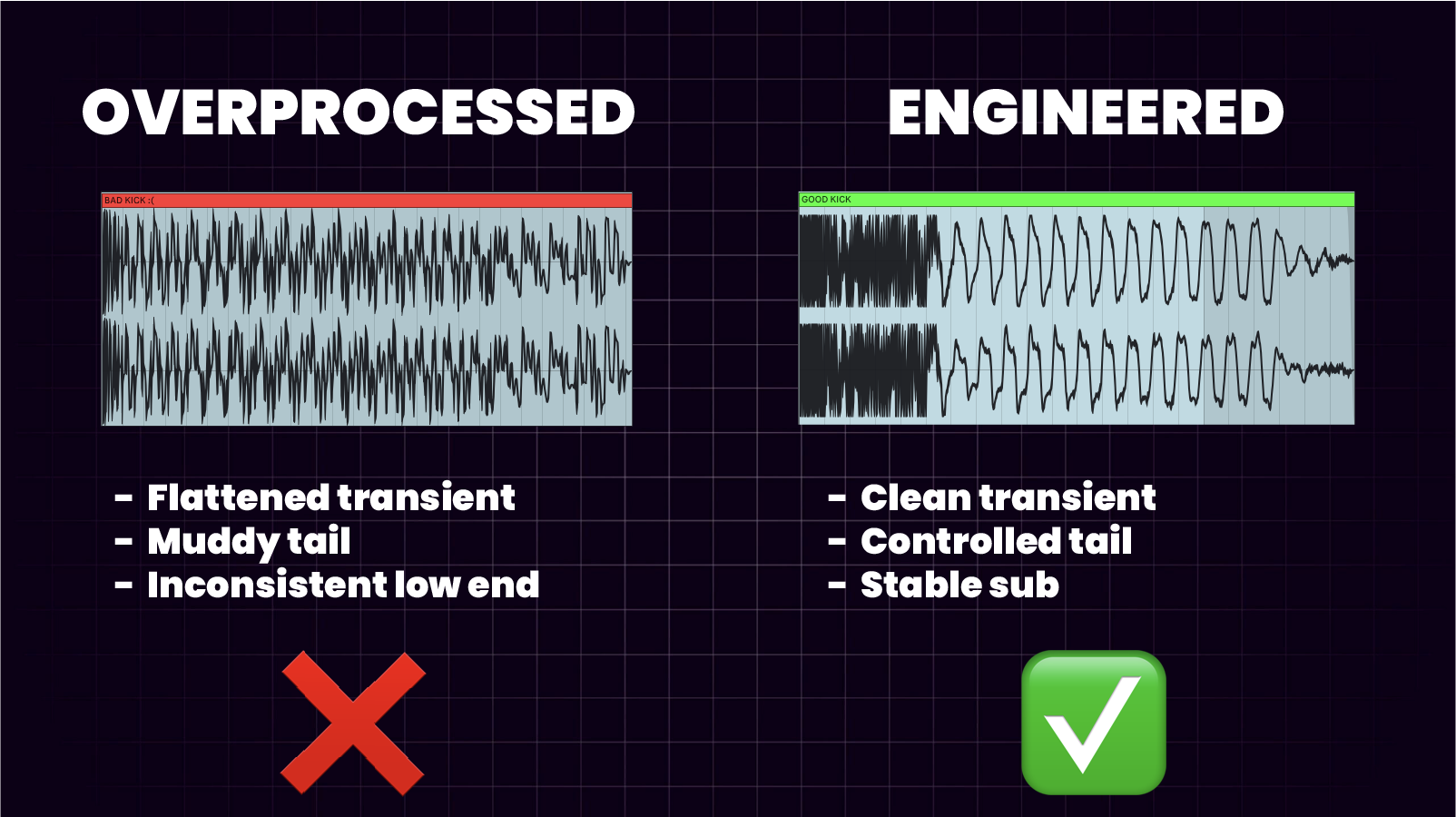
A serious hard techno sample pack follows strict production logic.
Kick Standards
- Fundamental tuned between 45 Hz and 65 Hz
- Punch defined in the 80 to 120 Hz range
- Clean mono compatibility below 120 Hz
- Controlled decay between 250 and 450 ms
- Transient window shaped within 5 to 15 ms
- Headroom preserved for clipping and mastering
Distortion Logic
- Harmonics generated intentionally
- Midrange aggression between 300 Hz and 2 kHz
- Bite preserved between 2 and 6 kHz
- No uncontrolled low-end distortion
Loudness Context
Modern club-ready hard techno often sits around:
- -4 to -7 LUFS integrated
- 1 to 3 dB controlled clipping
- Stable waveform density without flattening
If a sample pack ignores these fundamentals, it is not designed for real-world techno production.
It is designed to sell files.
Quality vs Quantity. The Producer Mindset Shift
Here is the uncomfortable truth.
Collecting thousands of random samples does not make you a better producer or famous.
It really slows you down.
When you open a folder with 10,000 samples:
- You lose time browsing
- You lose focus
- You lose creative direction
Professional producers operate differently.
They prefer:
- Curated collections
- Genre-specific sound design
- Tuned and phase-aligned material
- Organized folder structures
- Consistent sonic identity
Serious producers invest in tools. Hobbyists collect files.
And the difference shows in the final master.
How to Evaluate a Hard Techno Sample Pack Like a Pro
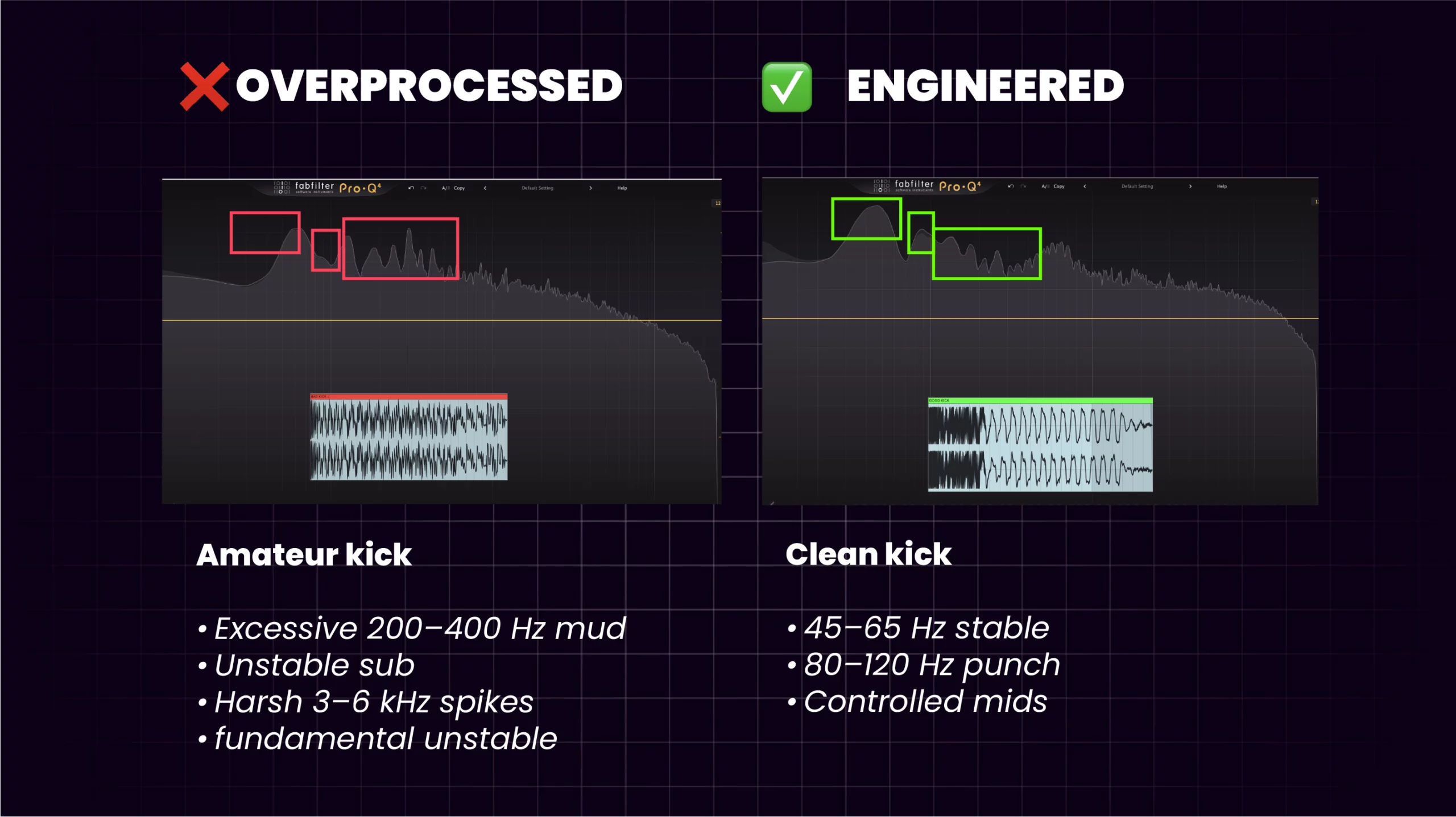
1. Are the kicks properly tuned?
Load a spectrum analyzer.
Check:
- Is the fundamental stable between 45 and 65 Hz?
- Does the sub wobble?
- Is there uncontrolled rumble below 30 Hz?
If yes, it is amateur engineering.
2. Does the pack respect mono compatibility?
Hard techno systems are brutal.
If the low end spreads in stereo below 120 Hz, it will collapse in a club.
Professional packs ensure:
- Sub frequencies are mono-safe
- Phase alignment is correct
- No artificial stereo tricks in the low end
3. Are the transients sharp and controlled?
Zoom into the waveform.
The first 5 to 15 ms define punch.
If the attack is soft or smeared, your track will lack impact, no matter how much distortion you add.
4. Is the distortion musical or chaotic?
Professional distortion:
- Adds harmonic density
- Preserves sub clarity
- Enhances aggression
Amateur distortion:
- Flattens transients
- Adds mud around 200 to 400 Hz
- Makes the kick sound loud but weak
5. Is the pack curated by genre specialists?
Hard techno is not generic techno.
It has:
- Industrial edge
- Warehouse energy
- Aggressive midrange
- Precise low-end discipline
If a pack claims to cover 15 genres at once, it probably masters none of them.
The Power of Curated Collections
One collection.
One sonic identity.
One expert mindset.
This is how serious producers work.
Instead of downloading random mega bundles, professionals choose:
- Industrial hard techno
- 150 BPM warehouse-focused sounds
- Rumble-ready kicks
- Distortion-ready drums
- Layer-friendly one-shots
Curated collections reduce decision fatigue and improve workflow speed.
When a pack is crafted by producers who actually release and perform hard techno since a while, you feel the difference immediately.
The kick sits.
The sub behaves.
The transient cuts.
If your production style leans toward even faster and more aggressive tempos above 160 BPM, exploring dedicated Hardcore Production : Explore Exclusive Packs from Angerfist, Neophyte, Hellfish can also expand your sound palette while maintaining the same quality standards.
Why So Many Modern Tracks Sound Amateur
This is not about taste.
It is about engineering discipline.
When producers rely on:
- Cheap mass-produced samples
- Overcompressed one-shots
- Untuned kicks
- Muddy low-end rumble
The result is predictable:
- No punch
- No clarity
- No authority
Hard techno is technical music.
It demands:
- Precision
- Control
- Respect for frequency balance
One day, you may want to release your own sample collection.
If the industry is devalued by ultra-cheap filler packs, sustainable professional sound design becomes impossible.
Quality over quantity is not elitism.
It is ecosystem preservation.
How Modern Producers Access High-Quality Hard Techno Samples
The industry has evolved beyond one-time downloads.
Professional platforms now offer:
Free tier access
Test curated packs before committing.
Monthly subscription
Consistent access to premium sound collections.
Annual subscription
Best value for serious producers building long-term projects.
Credit-based system
Buy exactly what you need. Single sounds or full collections.
This model encourages selection instead of hoarding.
With theses systems, instead of owning 10’000 random audio samples, you build a focused arsenal.
You can explore all access options, including free tier and credit-based purchasing, on our pricing page.
Smart Workflow. From Sample to Club Track
Professional workflow looks like this:
- Choose a tuned kick between 45 and 65 Hz
- Layer carefully and keep sub mono below 120 Hz
- Shape the transient between 5 and 15 ms
- Apply controlled distortion
- Clip 1 to 3 dB
- Leave headroom for mastering
For a complete breakdown of tuning fundamentals between 45 and 65 Hz, distortion staging and clipping strategy, read our full Hard techno Kick Tutorial 2026 – From Raw Samples to Club-Ready Monsters .
If you want to accelerate layering and distortion control, Specialized tools like Hammer can simplify stacking attack, body and sub layers without complex routing, especially when working with curated hard techno samples designed for layering.
But tools only work when your source samples are engineered properly.
The Professional Producer’s Checklist
Before choosing a hard techno sample pack, confirm:
- Fundamental tuned between 45 and 65 Hz
- Punch zone defined at 80 to 120 Hz
- Mono-compatible sub frequencies
- Clean transient window
- Controlled distortion stages
- No unnecessary filler content
- Organized, theme-based folders
- Designed for 145 to 155 BPM context
- Check for bad reviews and understand them before buying
- Check if AAA Artists (not influencers, or bots) are using it (real trust)
If these standards are not visible, reconsider.
Two Mindsets. Two Outcomes.
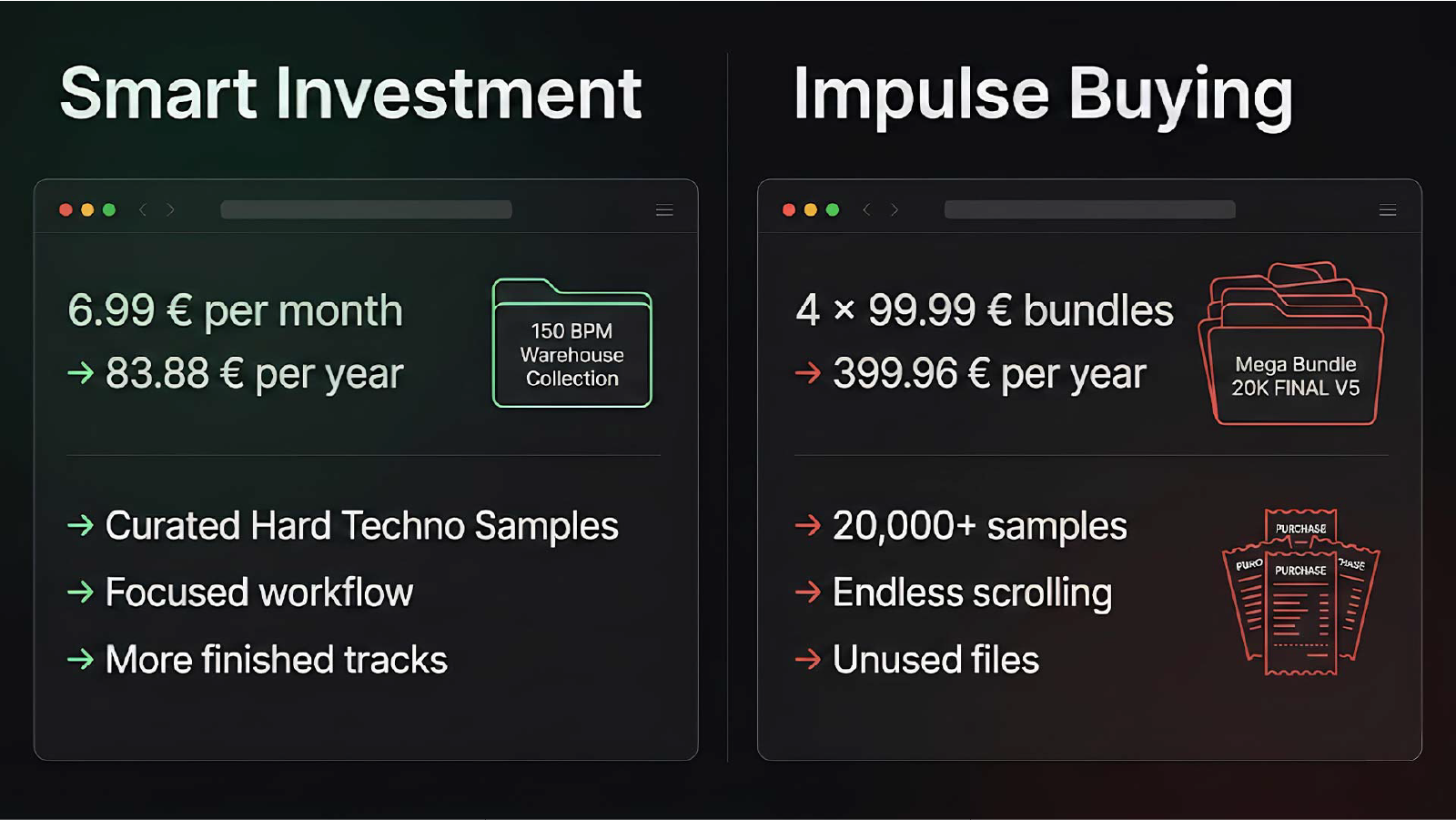
The difference becomes clear when comparing a curated sample workflow with the typical mega bundle approach shown below.
BILLY
Smart producer.
Spends time on sound selection
→ Subscribes to a curated hard techno sample platform
→ Every sound chosen with a production goal
→ Builds foundation faster
→ Wins time for arrangement, mixing, and mastering
→ Finishes impactful tracks
→ Saves money long term
result :
Focused workflow.
Strategic investment.
Consistent progression.
The Others
Driven by FOMO ads.
See “Everything Bundle 20’000 Samples”
→ Buy 4 to 5 mega packs per year
→ Spend hundreds of euros (€€€)
→ Download massive folders & Scroll endlessly
→ Use less than 0,1% percent of the content
→ Get overwhelmed
→ Struggle to finish tracks
→ Lose time & money
result :
Collection grows.
Progress slows.
Final Thoughts
Hard techno is not about aggression alone.
It is about precision under pressure.
If your kick collapses in mono, your track collapses in a club.
Choose your sample packs like a professional.
Because in this genre, engineering discipline is not optional.
It is the difference between amateur noise and controlled dance floor power.
FAQ
What BPM is hard techno usually produced at?
Modern hard techno typically runs between 145 and 155 BPM, with 150 BPM being the most common club tempo.
What makes a good hard techno sample pack?
Precise tuning, mono-compatible sub frequencies, controlled transients, curated genre focus and frequency-aware distortion engineering.
Are large sample packs better than curated ones?
Not necessarily. Large packs often contain filler. Curated collections offer higher consistency and faster workflow efficiency.
Why do many techno tracks sound amateur?
Poor source samples, untuned kicks, uncontrolled low-end distortion and lack of mono discipline are common causes.
Should I buy cheap sample packs?
Low price often reflects low engineering standards. Quality sound design requires expertise and time.
How many kick samples do I really need?
A few properly tuned, versatile kicks are more valuable than thousands of unusable ones.
Are subscription sample platforms worth it?
For serious producers building long-term projects, subscription access to curated collections can be more efficient than random purchases.
What frequency should hard techno kicks hit?
Typically between 45 Hz and 65 Hz for the fundamental, with punch in the 80 to 120 Hz range.
Do professional producers use sample packs?
Yes. Many professionals use curated sample collections as foundations, then customize and process them further.
What is a credit-based sample system?
A system where producers purchase credits and spend them on individual sounds or full collections instead of buying entire bundles blindly.
For exemple; We-Tweak, Splice, Loopmasters offers it. And the best at the moment for Hard Dance sounds stays We-Tweak.com.