The Quick Answer
To make a hard techno kick in 2026, start with a clean source, set your project around 150 BPM, tune the fundamental between 45 Hz and 65 Hz, shape the transient carefully, apply distortion in controlled stages, and manage peaks using soft clipping. Keep the low end mono and leave headroom for a powerful club master.
Hard techno in 2026 is heavier, sharper, and more refined than ever.
But power does not come from adding more distortion. It comes from precision.
In this guide, you will learn:
- The exact frequency zones that define a modern hard techno kick
- How to structure a distortion chain without destroying the sub
- How to layer kicks properly
- How to integrate the kick with rumble bass
- How to make your kick translate on real club systems
If you are serious about production, this is the foundation.
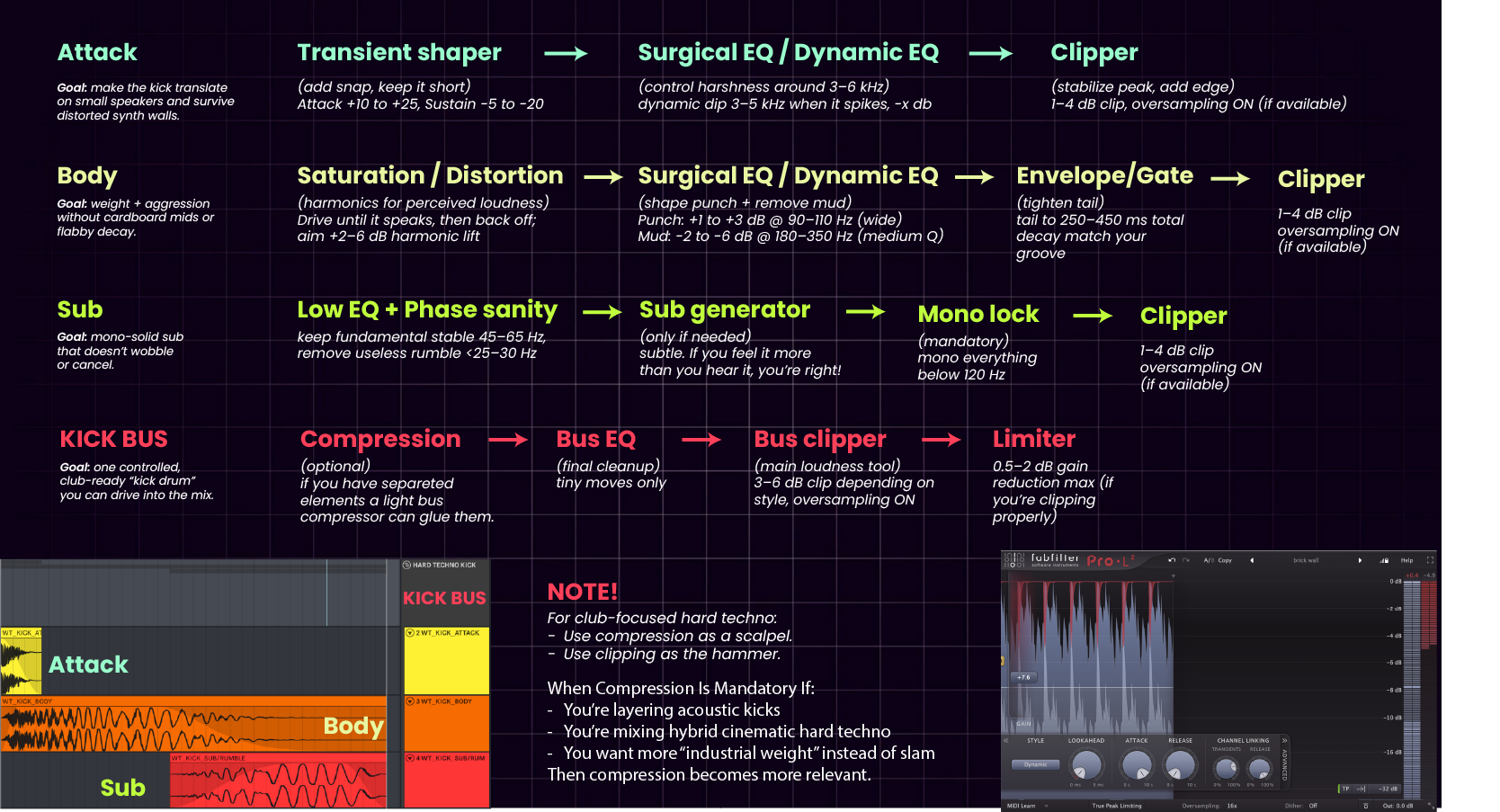
Step 6: Clipping Strategy
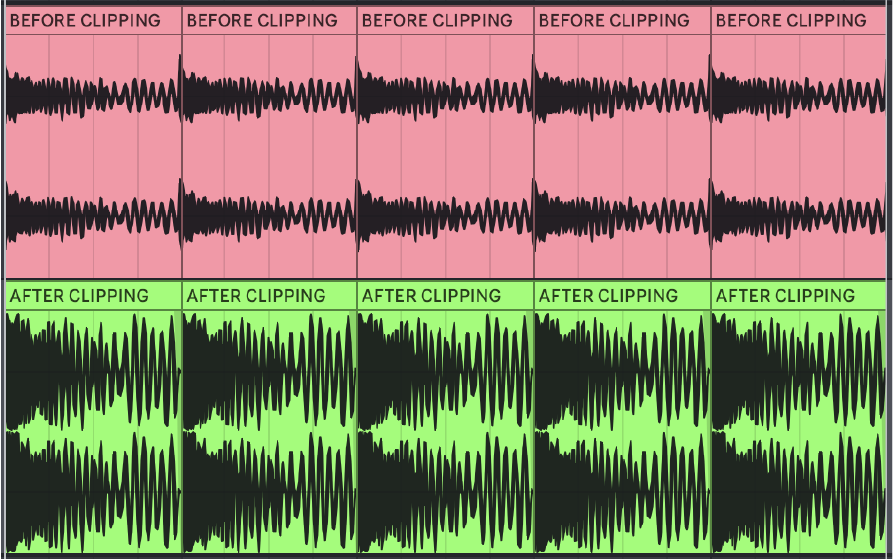
Modern hard techno often favors clipping over limiting.
Clipping adds density and perceived loudness without smoothing the transient too much.
Guidelines:
- Clip between 1 dB and 3 dB
- Avoid over-flattening the waveform
- Maintain headroom for mastering
Final peak ceiling recommendation: around -0.3 dB.
What Defines a Modern Hard Techno Kick in 2026?
Modern hard techno in 2026 typically runs between 145 BPM and 155 BPM, with 150 BPM dominating European club systems. At this tempo, the kick drum becomes the structural backbone of the entire mix.
A powerful hard techno kick is defined by:
- A stable fundamental between 45-65 Hz
- Strong punch in the 80-120 Hz range
- Controlled aggression in the midrange
- Clear transient presence between 2-6 kHz
- Tight decay between 250-450 ms
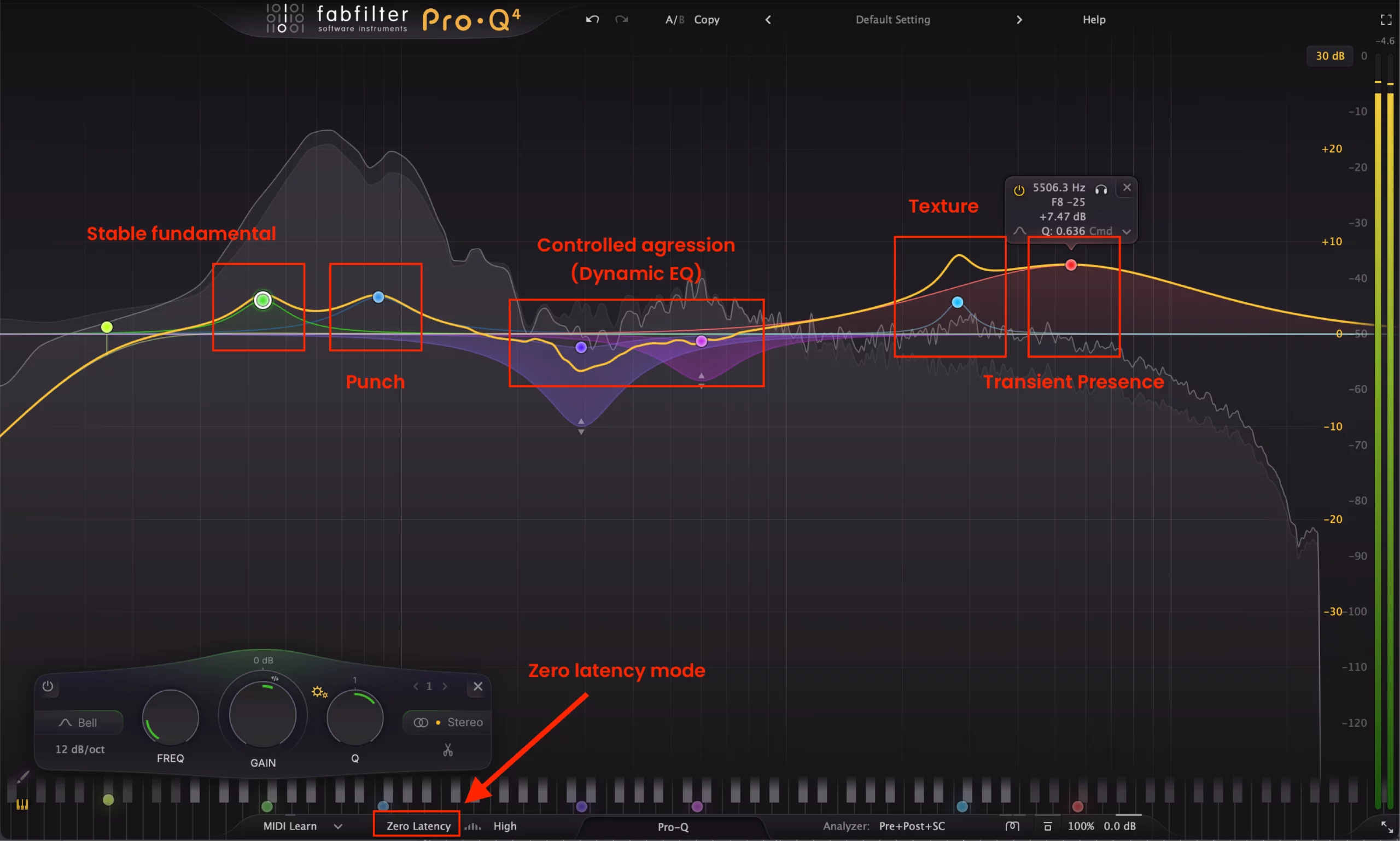
As shown in the EQ spectrum above, controlling these three zones with precise EQ and dynamic shaping ensures club translation on large systems running at 145–155 BPM.
A club ready kick must:
- Remain solid in mono
- Cut through distorted synth layers
- Maintain low-end integrity on large systems
If your kick collapses in mono, it will collapse in a club.
Step 1: Choose the Right Raw Kick Sample
Start with a clean, well-recorded source.
Good foundations include:
- Clean 909 inspired kicks
- Minimal processing one-shots
- Short industrial punch samples
Avoid:
- Heavily limited samples
- Over-distorted kicks
- Samples with uncontrolled low-end rumble
The cleaner the source, the more control you have during processing.
If you need strong starting material, explore our curated How to Choose Hard Techno Sample Packs Like a Professional Producer
Step 2: Tune the Kick Properly
Tuning is often ignored, but it defines impact.
For a modern hard techno track:
- 45 Hz to 55 Hz creates a deeper industrial feel
- 55 Hz to 65 Hz creates a tighter, more forward punch
Use a spectrum analyzer and listen carefully to the tail. The fundamental should feel stable, not wobbly.
If the kick fights your bass later, tuning is usually the reason.
Step 3: Shape the Transient
The transient defines perceived power.
Instead of boosting highs aggressively, focus on shaping the first 5 ms to 15 ms of the attack.
Tools you can use:
- Transient shaper
- Subtle EQ boost around 3 kHz to 5 kHz if needed
- The transient typically lasts between 5 ms and 15 ms in modern hard techno.
Controlling this micro-window defines perceived punch.
Be careful: too much click makes the kick thin and artificial.
Step 4: Build a Controlled Distortion Chain
Distortion should be layered, not stacked blindly.
A reliable structure:
- Pre-EQ (sub protection and tone shaping)
- Saturation stage for harmonic warmth
- Parallel distortion blended at 20-40 %
- Post-EQ to control harshness and sculpt aggression
- Soft clipping to stabilize peaks and increase perceived loudness
- (Optional) Multiband processing for midrange control
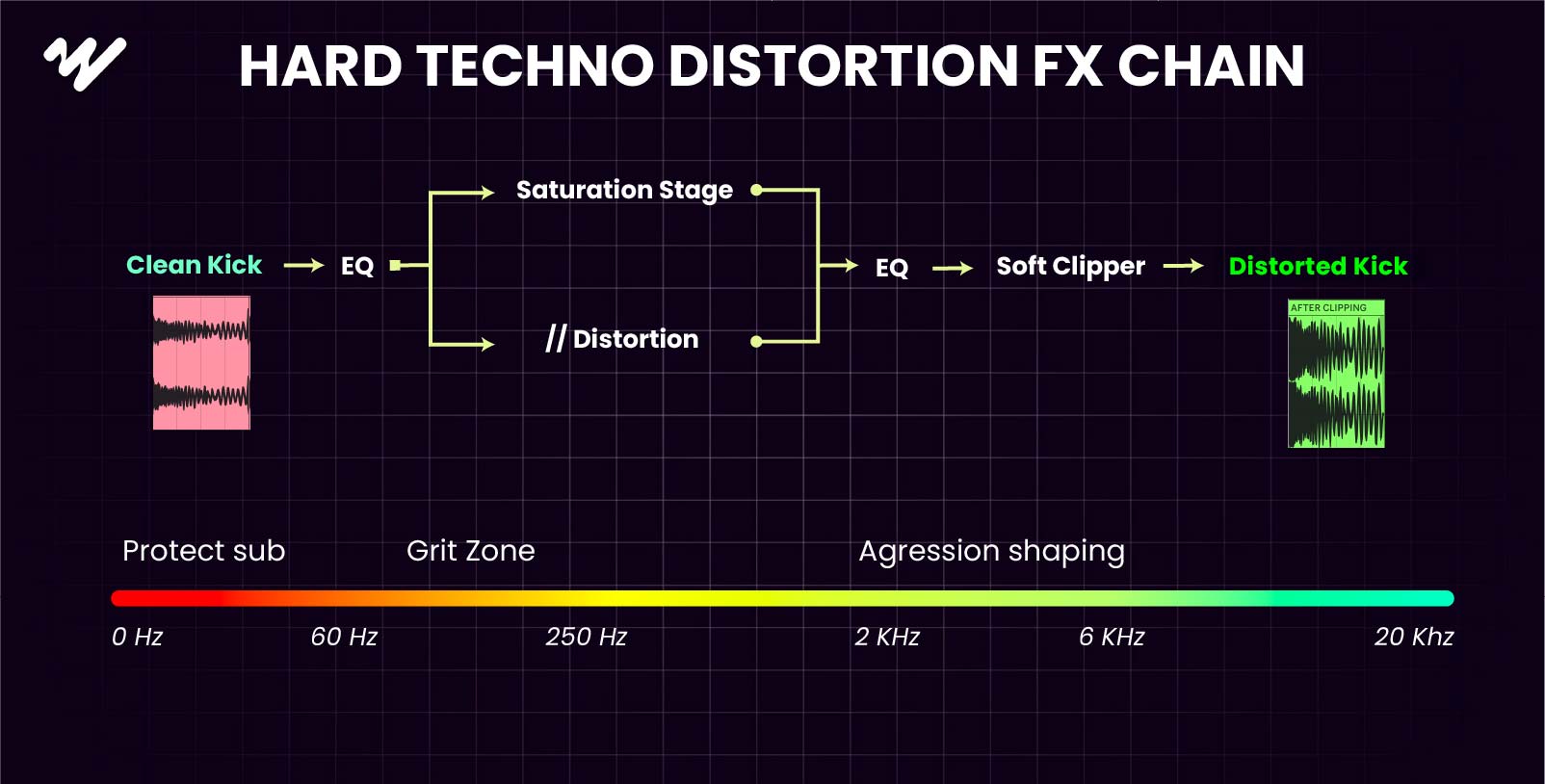
Important frequency logic:
- 0-60 Hz: protect the sub (keep clean and mono)
- 80-250 Hz: add controlled grit and weight
- 300 Hz-2 kHz: develop aggression and density
- 2-6 kHz: maintain bite and speaker translation
Distortion generates harmonics across the spectrum.
Without pre-EQ and post-EQ control, those harmonics will muddy the low end and exaggerate harsh upper mids.
If you distort everything equally, the sub will lose clarity and the kick will collapse in mono on large systems.
For deeper processing strategies, see our full guide on Hard Techno Distortion: How to Add Aggression Without Ruining Your Mix
Step 5: Layering the Kick Correctly
Layering is optional but powerful when done right.
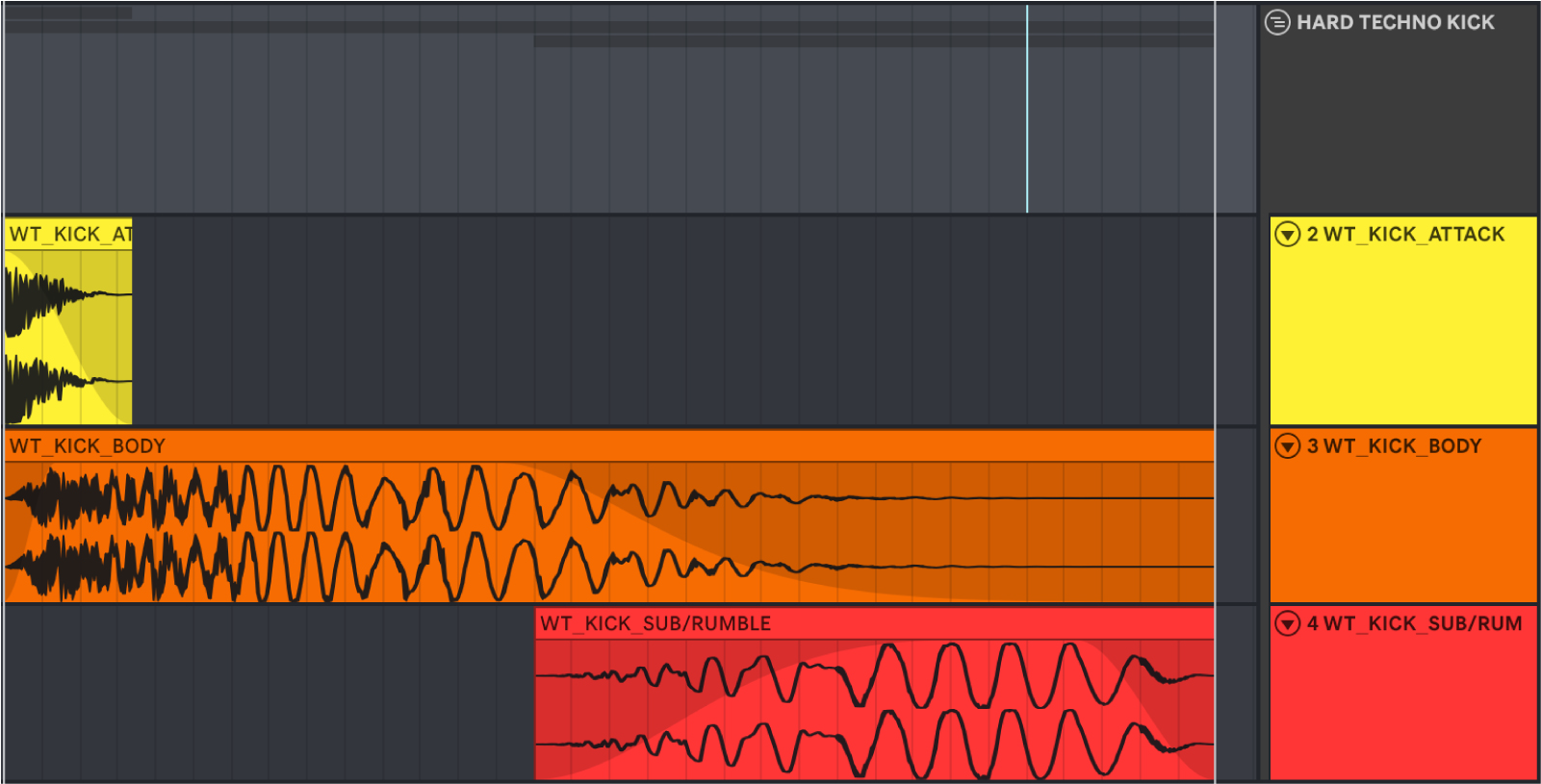
Common structure:
- Sub layer: clean and mono
- Body layer: distorted character
- Click layer: short attack
Keep everything below roughly 120 Hz in mono.
Want to Speed Up the Layering Process?
Layering hard techno kicks manually can be precise but time-consuming.
Aligning transients, controlling phase, and balancing sub/body/attack layers often requires multiple routing steps.
That’s exactly why we built Hammer plugin a dedicated VST designed to simplify hard dance kick samples layering.
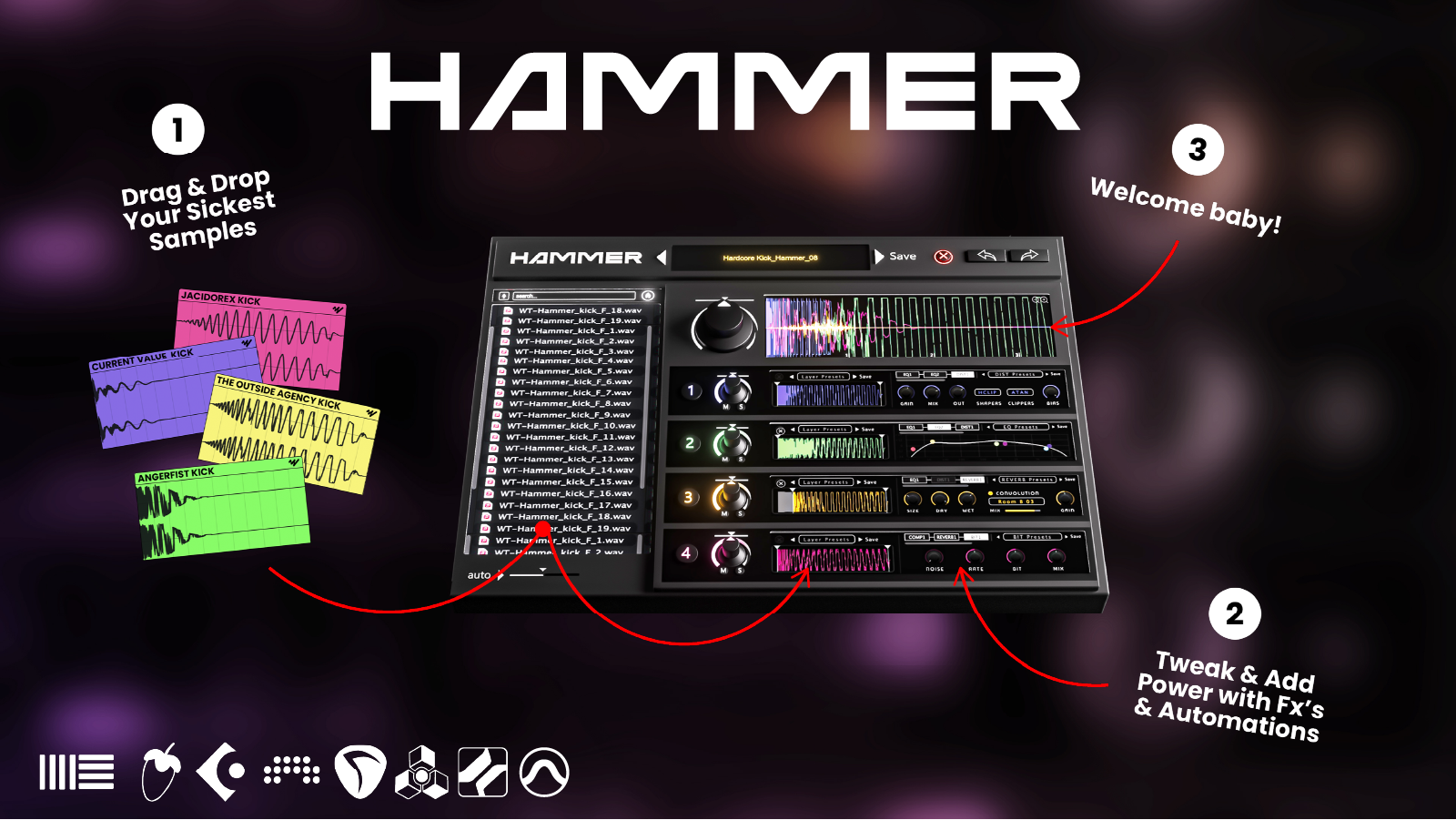
Hammer allows you to:
- 4 Layers: Stack attack, body and sub samples instantly
- Every step in one plugin
- Shape FX chain per layer and final master
- Keep low-end mono without complex routing
- Build hard dance kicks in minutes instead of hours!
If you want to accelerate your workflow without sacrificing control, explore 👉 Hammer here
Step 7: Kick and Rumble Integration
In hard techno, the rumble often follows the kick rhythmically. The kick must always stay dominant.
Three essential rules:
- Carve space in the rumble around the kick’s fundamental
- Use sidechain compression with a release between 80 ms and 150 ms
- Control the 100 Hz to 150 Hz zone to avoid low-end mud
If the rumble feels louder than the kick, your groove will lose impact.
Step 8: Make It Club Ready
Before finalizing your kick, test it in different environments:
- Mono playback
- Low listening volume
- Headphones
- Studio monitors
Focus on:
- Stable 50 Hz to 80 Hz energy
- No boxy buildup around 200 Hz to 400 Hz
- Clear transient even at low volume
- If you using FabFilter Pro Q4 : Use Zero Latency mode to preserve transient punch. (Linear Phase can introduce pre-ringing which softens the attack and it’s not ideal for aggressive hard techno kicks.
If it works quietly, it will explode loudly.
Final Hard Techno Kick Checklist
Before exporting:
- Fundamental tuned between 45 Hz and 65 Hz
- Controlled distortion stages
- Sub frequencies in mono
- No phase cancellation
- Clean headroom maintained
If all of these are correct, your kick is ready for club systems.
FAQ
What BPM is hard techno in 2026?
Most modern hard techno tracks sit between 145 BPM and 155 BPM, with 150 BPM being the most common club tempo.
What frequency should a hard techno kick hit?
The fundamental usually sits between 45 Hz and 65 Hz, with additional punch in the 80 Hz to 120 Hz area.
Should you clip hard techno kicks?
Yes, controlled clipping between 1 dB and 3 dB can enhance aggression while keeping transients sharp.
Which tools should I use to make hard techno kicks?
There are two main approaches:
- Sample-based workflow using layered kick samples
- Full sound design workflow using synthesis and custom processing
Most producers start from strong samples and refine them to create a unique signature. What matters most is how you process and balance the kick inside the mix.
If you want professionally designed starting points, explore our Hard samples Starter Collection.
Why does my hard techno kick lose power in mono?
Phase misalignment, excessive stereo widening below 120 Hz, or uncontrolled distortion in the sub range are the most common causes.